


Seeing surrealist paintings feels like stepping into a strange, dreamlike world where familiar or iconic objects are rearranged in surprising ways. The newly opened "Reality Surreality" exhibition brings together nearly 100 works by 53 Chinese artists. You may feel curious, puzzled, and a little unsettled—but also full of wonder.
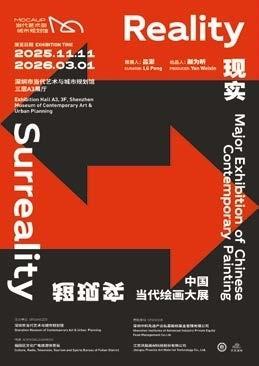
A poster for the exhibition.
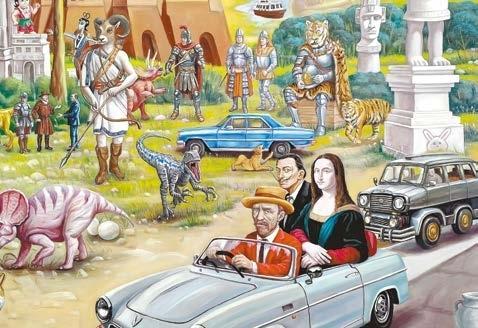
Part of Xiong Tao's oil painting "From Easter Island to Atlantis" (2025). Photos by Cao Zhen
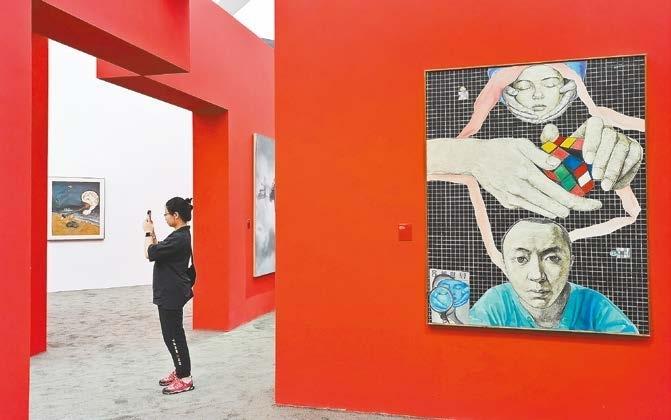
A visitor observes paintings at the exhibition.
Curated by art historian Lyu Peng, the exhibition spans works from the 1980s to the present, tracing Chinese artists' evolving experiments in painterly language. From an art history perspective, it reviews four decades of Chinese surrealist painting while offering a glimpse into the diversity and complexity of contemporary Chinese society.
According to the exhibition's curatorial statement, economic development, urban transformation, environmental challenges, technological advances, and cultural integration have broadened our understanding of reality; surrealist painting has provided artists with a freer mode of expression.
Today's surrealism responds to information overload, rapid technological change, and global cultural exchange, reshaping artists' sensibilities and influencing their themes and imagery.
In the exhibited paintings, influences of Salvador Dalí, Giorgio de Chirico, Max Ernst, and René Magritte can still be found in some younger Chinese painters, yet these influences are fused with the lived experiences of the present era.
The dreamlike scenes in these works serves as a powerful means for contemporary artists to probe the inner self and convey independent thought. As a result, surrealist modes continue to exert sustained influence within the increasingly intricate and multidimensional landscape of Chinese contemporary painting.
Dates: Through March 1, 2026
Venue: Shenzhen Museum of Contemporary Art and Urban Planning, Futian District (深圳市当代艺术与城市规划馆)
Metro: Line 3 or 4 to Children's Palace Station (少年宫站), Exit A2