



Last night, Shenzhen visited me — not just as it exists now, but as it once was, and as it might one day become.
I went to bed without any expectation of what I was about to witness. The sun rose slowly over a bay in southern China, and the air carried the faint scent of salt and sea mist. The roads were still unpaved, covered in dust.
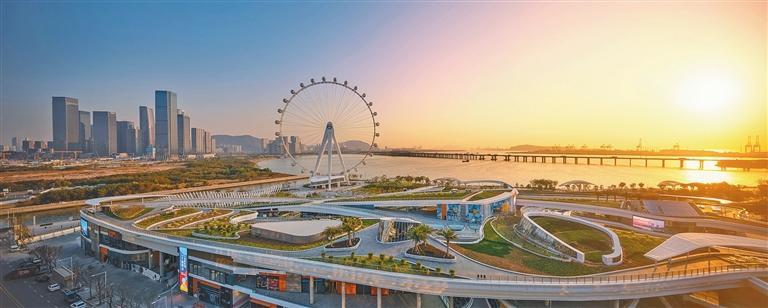
A general view of Shenzhen's Bao'an District. File photo
Feige brand bicycles glided past, their bells ringing softly into the morning calm. From a distant loudspeaker, the sweet, familiar voice of Teresa Teng drifted through the air, "Sweet as Honey" playing gently over the quiet hum of the waking city. I stirred awake, the smell of old blankets around me, and pulled the covers over my head. As I drifted deeper, time folded once again.
In the dream, the city ascended like a forest of glass and light, miraculously growing from the earth. Where dusty roads once lay, gleaming towers now stood, touching the sky. Screens glowed on every corner; drones buzzed softly above tree-lined streets. Along wide, clean avenues, electric cars glided silently — no more bicycles, but sleek vehicles weaving through crowds of people rushing to work. Cafés serving hand-brewed coffee stood beside stalls selling spicy noodles; tradition and innovation shared the same sidewalk.
In the heart of this city, the Ping An tower pierced the sky, surrounded by tech giants — Huawei, Tencent, DJI — the new temples of invention. Parks bloomed with tropical flowers, and at night, the skyline transformed into a river of light, reflected in the bay.
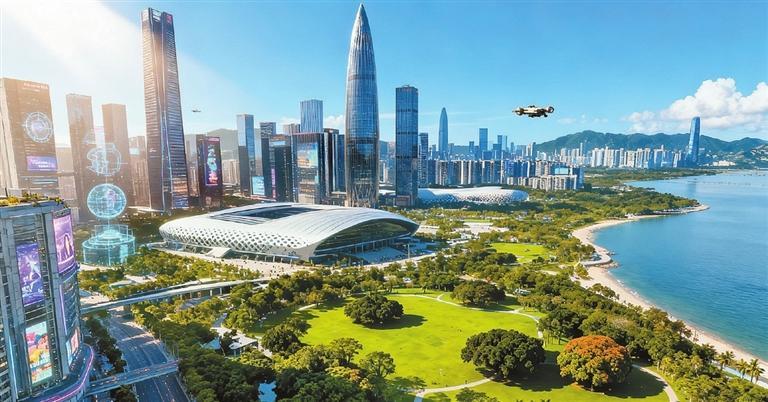
An AI-generated image of the future city of Shenzhen. Doubao AI
The air hummed with energy, like a city that never sleeps because it is too busy creating tomorrow. I heard not only Mandarin, but English, Cantonese, and dozens of accents from every corner of China and beyond.
I woke up again, only to fall deeper into sleep. The city shifted once more. This time, I saw wonders.
The sun rose over a city of light. In the sky, flying cars glided effortlessly between silver towers, their paths guided by invisible streams of data. The air was still — free of smoke and traffic noise — filled only by the soft hum of drones delivering breakfast to balconies made of glass that can repair itself. Trees along the streets glowed faintly at night, powered by bioluminescent energy.
People walked without phones; smart lenses projected messages and maps directly into their vision. Robots swept the streets, polite and silent, while children played with holographic pets that chased birds across the parks. Above the bay, a giant floating platform collected solar and tidal energy, powering the entire city. AI traffic lights read the rhythm of human movement, adjusting their signals like a symphony conductor.
At the harbor, autonomous ships glided in and out, connecting this shining metropolis with cities across the Pacific. And in the middle of it all, the old market still stood, its aromas of noodles and tea mingling with the electric air — a reminder that even in the most futuristic world, the heart of the city remains human.
I wake up now, the remnants of the dream still lingering in the quiet of my room. The sounds of the city slowly seep in — car horns, distant chatter, the shuffle of hurried feet.
It's not the world of drones and flying cars from my dream, yet there's something here, something familiar yet unfamiliar, that already feels like part of the future.
Even though the dream didn't show the familiar faces of my teachers, friends, and locals I've met here, whose warmth makes this city feel like home, I still knew it was Shenzhen.
It didn't show the laughter of playing basketball with my Chinese friends, or their patience as they teach me new words. It didn't show the smiling vendor who chats with me about my country while stirring my fried rice in his big, traditional wok.
It didn't show the martial arts classes on Thursdays, or the taste of mooncakes and zongzi during festivals. Yet somehow, I was certain — the city in my dream was Shenzhen, its past, present, and future all intertwined.
The Shenzhen I live in today isn't the utopian city of my dream, but it is on its way. The streets are lined with glass towers, yet the air still carries the warmth of tradition. The faces I pass each day, though rushed, still hold the possibility of connection.
It's a city in transition, caught between what it was and what it will become, and I am finding my place in this dance between the past and the future, one step at a time. Maybe Shenzhen isn't just a city in my dream — it's a dream in progress, and I'm lucky enough to be living inside it.