


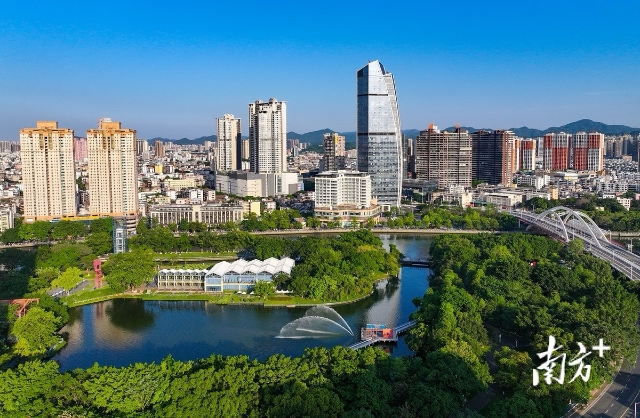
(Photo: Nanfang Plus)
Zhongshan, a manufacturing hub in southern China's Guangdong province, is on track to push its gross domestic product beyond RMB 420 billion (USD 60 billion) by the end of 2025, local officials said, outlining the city's economic performance as China's current national development cycle draws to a close.
The figures were released at a press conference held in Guangzhou on Wednesday (Dec. 31), as part of a series reviewing the province's development during China's 14th Five-Year Plan period (2021-2025), a nationwide framework that sets priorities for economic growth, industrial upgrading, and social development.
Located on the west bank of the Pearl River estuary, directly opposite Shenzhen, Zhongshan is part of the Guangdong-Hong Kong-Macao Greater Bay Area (GBA), a state-led initiative integrating 11 cities into a globally competitive economic cluster. Improved regional connectivity has reshaped the city's growth outlook.
According to Mayor Yin Nianhong, Zhongshan's GDP crossed the RMB 350 billion and RMB 400 billion thresholds during the plan period. The number of registered market entities reached 740,000, up 60% from five years earlier. Ten major industrial clusters now generate a combined output exceeding RMB 700 billion, while industrial investment in 2024 was double the 2021 level.
A key catalyst has been the opening of the Shenzhen-Zhongshan Link, a cross-sea bridge-tunnel project that has cut travel time between the two cities to under an hour. Average daily traffic has reached nearly 88,000 vehicles, strengthening labor mobility and industrial coordination.
Zhongshan has also redeveloped more than 52,000 mu (3,500 hectares) of low-efficiency industrial land since 2022, attracting over RMB 200 billion in new investment. Factory floor-area ratios have risen sharply, easing long-standing land constraints.
Environmental and governance reforms have run in parallel. More than RMB 20 billion has been invested in sewage treatment and pipeline networks since 2021, while administrative reforms have cut construction approval times by nearly 65%.
Manufacturing remains the backbone of the economy. Over 90% of large industrial firms have completed digital upgrades, and Zhongshan hosts 57 nationally recognized "little giant" technology firms (SMEs officially recognized for their strength in niche technologies and innovation). Emerging sectors are expanding, with over 650 biomedicine companies and double-digit growth in renewable energy and advanced equipment manufacturing. Annual research and development spending has exceeded RMB 10 billion for three consecutive years.
As the current Five-Year Plan concludes, Zhongshan's trajectory highlights how mid-sized Chinese manufacturing cities are using infrastructure, reform, and industrial upgrading to reposition themselves within the Greater Bay Area's evolving economic landscape.
Reporter: Zeng Xiangxing
Editor: Hu Nan, James Campion, Shen He