


Guangdong had more than 20,000 foreign students by the end of 2025, with 105 universities approved to enroll international students, the province's education authorities said at a press conference on January 7. The figures were released as part of a broader review of Guangdong's education development during China's 14th Five-Year Plan period, which runs from 2021 to 2025.
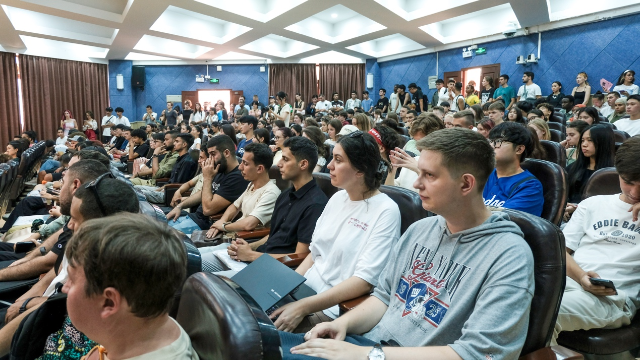
International students attend a semester opening ceremony at Guangdong University of Foreign Studies, September 2, 2024.
Guangdong as a gateway: expanding international education
Long seen as one of China's most outward-facing provinces, Guangdong has prioritized educational exchanges as an essential part of its opening-up efforts.
Officials stated that the province has expanded the recruitment of overseas students while also improving access for students from Hong Kong, Macao, and Taiwan.
Twelve schools for children from Hong Kong and Macao have been established across Guangdong. Nearly 110,000 students from Hong Kong, Macao, and Taiwan are now enrolled in kindergartens, primary, and secondary schools in the province. At the university level, 76 institutions are authorized to admit students from Hong Kong, Macao, and Taiwan, with about 22,000 currently enrolled across the province.
Meanwhile, cross-border cooperation has become a key feature of higher education. The province is now home to six universities jointly run by Chinese mainland and overseas partners, accounting for more than half of China's total. There are also 48 joint undergraduate and postgraduate programs.
Three universities from Macao, including the University of Macau, have been approved to extend their operations into the Guangdong–Macao In-Depth Cooperation Zone in Hengqin, while Sun Yat-sen University has established a research and teaching institution in Hong Kong as another sign of closer ties.
Officials added that 22 "Lingnan Craftsman Institutes" have been established, a program launched in 2024 to encourage vocational colleges to expand international cooperation. Meanwhile, 35 vocational institutions from the province have launched 93 overseas education programs in the Belt and Road countries.
Updating education to meet technology and industry shifts
In response to the new wave of technological and industrial change, Guangdong universities have introduced more than 400 undergraduate programs in areas such as robotics, integrated circuits, and artificial intelligence.
As a major center for science and technology innovation, the province has seen its universities play an important role in research. Over the past five years, they have led the establishment of 13 national key laboratories.
Vocational education has also expanded to support Guangdong's strong manufacturing sector. New higher vocational colleges have been set up, achieving full coverage across all 21 cities. Five undergraduate-level vocational universities have been added, bringing the provincial total to seven, the highest in China.
By the end of 2025, Guangdong had 36,868 schools of all types, serving 27.66 million students and employing 1.68 million full-time teachers.
Reporter | Chen Siyuan
Photo | Chen Siyuan
Editor | Hu Nan, James Campion, Shen He


