



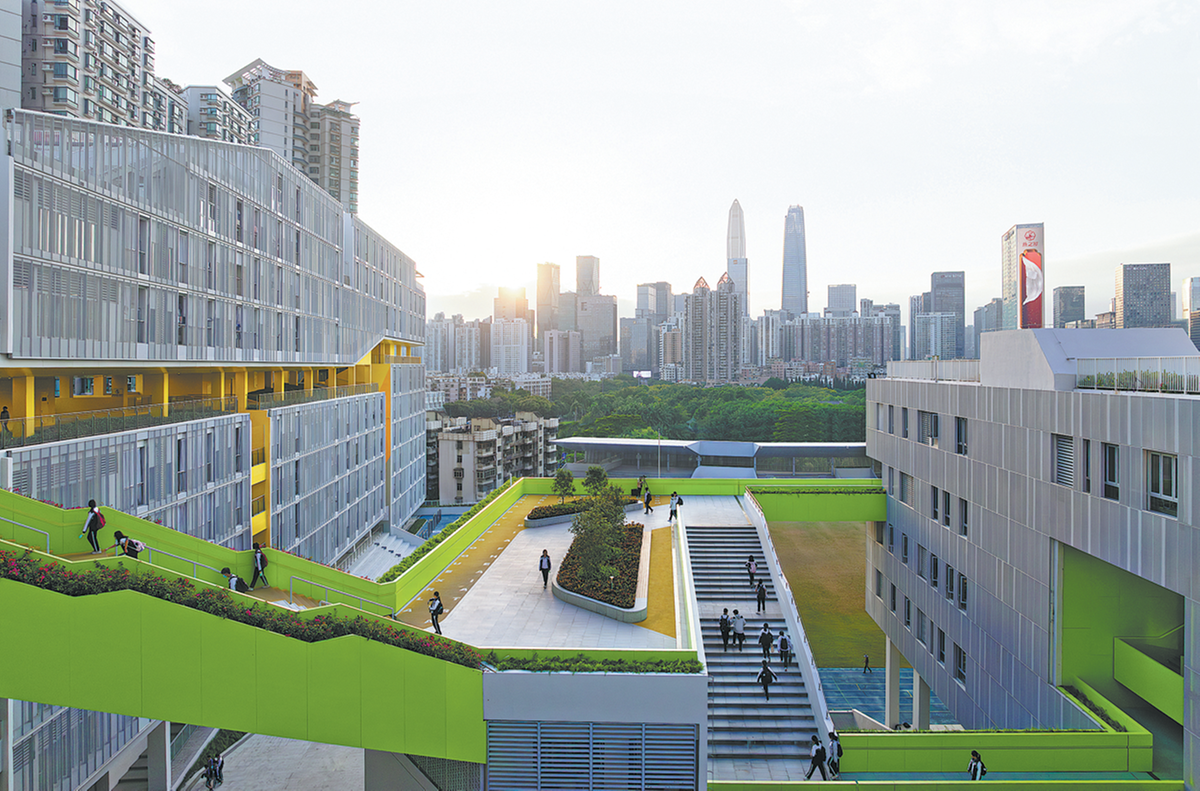
The open model makes Futian High School a center of community life in Shenzhen, Guangdong province. CHINA DAILY
Six years after completion of the Hongling Experimental Primary School in Guangdong province, architect He Jianxiang still finds himself drawn back to the school.
Sometimes, he brings international architecture peers, other times educational delegations, to the futuristic school at the foot of Antuo Hill in Shenzhen.
And without fail, as the school day ends, he witnesses the same scene — children racing across the semi-underground indoor basketball court, examining crops in the rooftop garden, chasing through corridors of seemingly impossible width and playing in the sunken, landscaped courtyards.
All are evidently in no hurry to go home, and their laughter fills the space.
"This is the most fulfilling feedback I could ever receive," said He, the lead architect behind the school, which was feted as the first to crack the local puzzle of a high-density school in a city, with a population comparable to Beijing's, yet with a land area only one-eighth the size.
Completed in 2018, Hongling school in Futian district was the earliest and most influential project to emerge from Shenzhen's "new campus action plan".
The plan was driven by a city in a building crisis and in particular, a desperate shortage of student places.
In 2017, local authorities launched a five-year plan with a total investment of 400 billion yuan ($56.3 billion) that outlined the construction of 247 new schools in Shenzhen, aiming to add 740,000 new student places.
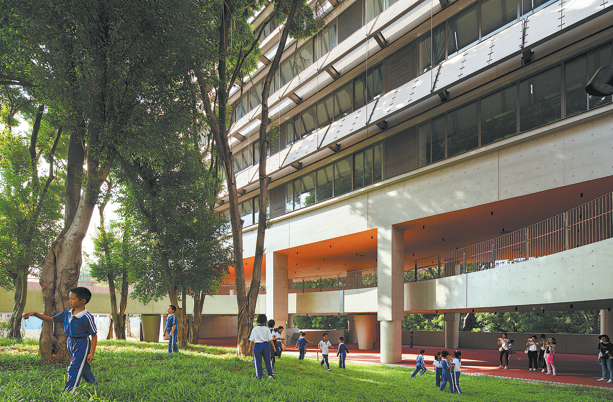
Students play in the school yard at Liyuan Foreign Language Primary School in Shenzhen. CHINA DAILY
In Futian, the city's bustling core where land is at a premium, the need was especially acute.
The mandate was tricky. To solve the chronic shortage, new schools had to accommodate 1.5 times the planned number of classes, requiring three to four times the standard floor area, all on tiny urban plots.
Rising from 'chaos'
When He first stood on the planned site for the Hongling school in 2017, he saw barren yellow earth, leveled from the former Antuo Hill quarry, and roads yet to be paved."It was a scene of chaos, nothing but construction vehicles," he recalled.
This "blank slate" offered no existing urban context to work with, but the task was brutally clear — on a tight 1-hectare plot, a planned 24-class school needed to be expanded to 36 classes. The total gross floor area, excluding basements, needed to cover 25,000 square meters, resulting in a floor area ratio over three times that of a traditional primary school.
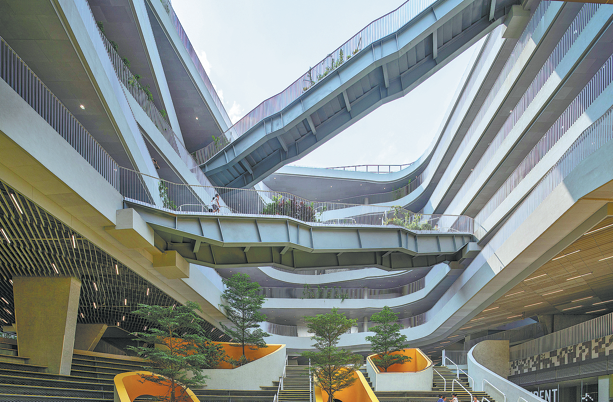
Students play at the outdoor theater of the Hongling Experimental Primary School in Shenzhen. CHINA DAILY
"It was like fitting three times the building mass on the same footprint," He explained. Despite the challenge, his team set a red line for themselves — the building height could not exceed 24 meters.
This was a crucial self-imposed limit, as surpassing it would require meeting national fire codes such as enclosed stairwells with lobbies, which He believed would severely hinder the children's freedom of movement and interaction.
Faced with the dual pressures of extreme density and rigid regulations, the conventional approach would have been to use standardized, repetitive, rectangular units to create a building.
He rejected this shortcut. "It's a fast way to design, but it makes for very dull cities and buildings," he said.
At the time, his own child was in kindergarten, giving him a personal perspective on the challenge. "We wanted a place where children could explore freely," he said.
He found inspiration from local terraced geographical features and conceived two valley-like sunken courtyards from which arched floor slabs, ramps and corridors "organically grew".
Yet, compressing the building mass meant an incredibly high density, which clashed with another national standard that every classroom must receive at least one hour of direct sunlight on the winter solstice.
"This consumed a huge amount of our effort," He said, pointing to the intricately intertwined corridors and buildings. "What you see as these 'twisting' forms are largely the result of precise calibration to ensure even the lowest floors meet the code."
Now, the hexagonal-shaped classrooms perfectly support the school's project-based teaching model, while the partition between two classrooms can be opened, allowing classes to split or merge. Desks can be reconfigured for various teaching styles.
The sloped, curved corridors have become the children's favorites, as they can joyfully slide down on their knees. The sunken courtyards host the library and art rooms, creating a seamless flow between inside and outside, allowing lessons to spill naturally into the open air, the architect said.
"Last time I brought architects from Belgium, we happened to see children drawing the school's spaces. It seemed that the entire campus was their first project for inquiry," He said.
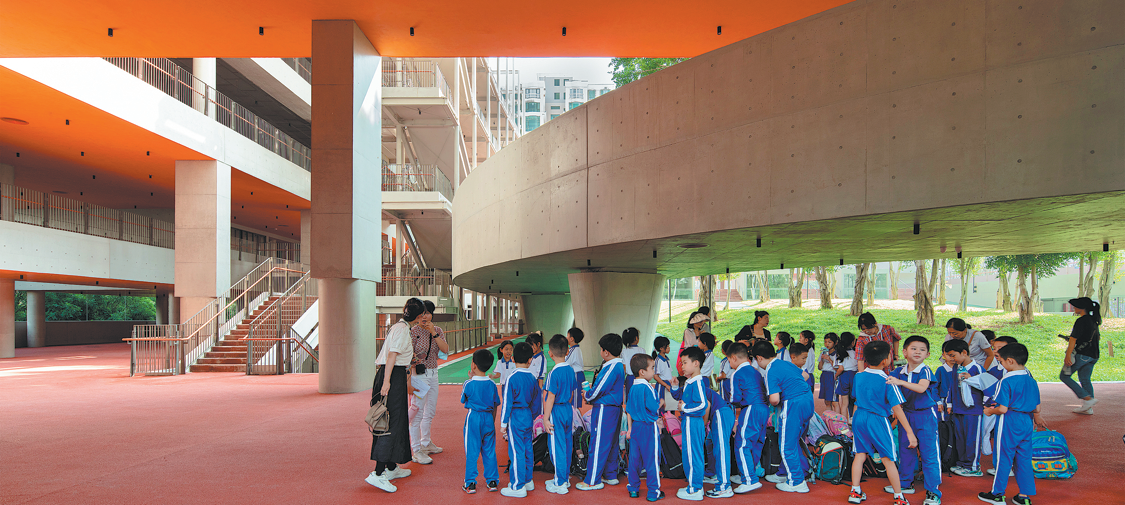
Children gather at Liyuan Foreign Language Primary School. CHINA DAILY
Gateway opened
Hongling school was the first tangible success of a radical urban experiment.
"It was the first to truly crack the 'high-density school' puzzle," said Zhou Hongmei, the mastermind of the campus action plan.
In 2017, Zhou faced immense pressure as deputy director of the Futian district planning bureau. The district's school shortage was so severe that parents' complaints were overwhelming.
At the time, the high-density campus was "uncharted territory" in architecture, devoid of precedents, theory, or management experience, Zhou recalled.
From her position in the approval process, she decided to step into the front line, initiating a "quasi-utopian" experiment. In just 10 days, she organized a design plan with three architecture firms.
He's team was invited and its scheme stood out for satisfying both the high-density demand and children's need for a campus that is both functional and beautiful.
Zhou admitted that the endeavor was, at first, an "illegal experiment". Her model did not fully comply with standard public bidding procedures. Yet, when Hongling was successfully completed, a gateway to a "brave new world" was opened.
The constraints unleashed a torrent of creativity among ingenious architects who had been previously shut out of bidding on projects. They have since placed running tracks on rooftops, created rooftop farms, and weaved sky bridges and courtyards between buildings, overcoming the rigid, outdated aesthetics of the past.
"It was precisely because we used institutional innovation to attract the 'Olympiad-level contestants', the high-density equation was solved," Zhou explained.
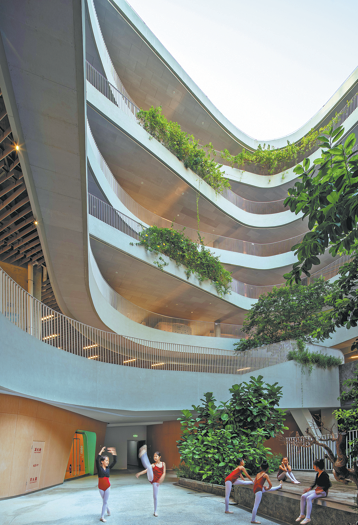
Students practice dancing at the sunken courtyard of the Hongling Experimental Primary School. CHINA DAILY
A key obstacle was the traditional "turnkey project" model, where schools were designed and built with minimal input from the eventual users, she said. This left the needs of teachers and students, and the spatial ideals of architects, misaligned.
Zhou's solution was an alliance-exhibition mechanism, a hybrid of a "cluster design" practice and an open competition. "Whenever architecture faces a turning point, masters gather to propose new ideas — this is an alliance or cluster design," she explained.
She established academic committees to provide professional oversight from planning and selection to final review.
Crucially, this mechanism brought the users — the schools — into the process early and gave them deep involvement.
"Our biggest highlight is involving the school side from the very beginning of the design competition right through to implementation," she said. This stood in stark contrast to the turnkey model, where a principal might not see their school until being handed the keys.
Zhou also pioneered a collaborative working platform, where she brought all the departments together to deliberate from the start. Officials from planning, water services, fire safety, and other related parties sat down together to reach a consensus.
Riding this momentum, Zhou expanded the groundbreaking approach from Futian to Shenzhen's Longgang and Nanshan districts, giving rise to more than 100 proposals for 35 schools.
In March 2022, this evolution culminated in the "Nanshan one hundred schools renewal" action, targeting 143 aging kindergartens and schools in the district for innovative, low-cost renovations.
It transformed kindergartens into learning playgrounds where children can climb onto the roofs, and play and move freely on terraces. Once closed-off, crowded spaces were opened up by removing walls, allowing children to visit neighboring classes.
In early November, the Nanshan renewal action was awarded the urban innovation prize at the 3rd City For Humanity Awards hosted by the popular Beijing-based Sanlian Lifeweek magazine.
The jury praised it as a "contemporary interpretation of Shenzhen's 'dare to be the first' spirit", noting that through this massive creative renewal of campus spaces, the city's fearless innovative ethos is being subtly passed down to a new generation.
Shared resource
Older students have also benefited from Zhou's reforms, including those at Futian High School, about 5 kilometers from the Hongling school.
Architect Chen Chen vividly remembers the formidable task facing his team at the beginning of the building process. The new site for the school was on the last undeveloped plot in a hyper-dense district, squeezed by high-rises on three sides and a major road on the other.
The team's solution was a "porous campus" strategy, in which they lifted the 400-meter running track onto a platform, carved light wells into the deep podium, and threaded aerial walkways, dubbed "The Loop", through the complex. This "multi-ground system" created a vertical tapestry of courtyards, roof gardens, and interconnected social spaces.
The most groundbreaking aspect, however, was how the school engaged with the city.
The Futian school was designed to be a shared civic resource, with a dual-entry system that separates student and "community circulation", Chen said.
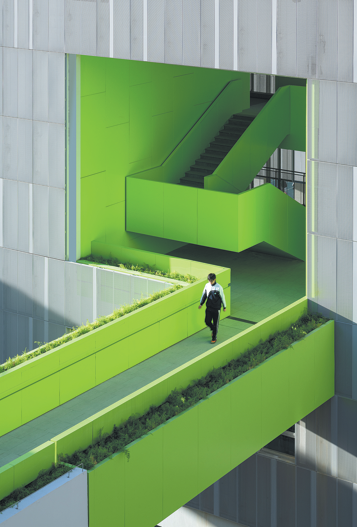
A student walks through a bridge between two teaching buildings at Futian High School. CHINA DAILY
Theaters, sports halls, and the swimming pool are positioned along the city-facing side with independent lobbies, allowing the spaces to be safely opened to the public on weekends and in the evenings, he said.
"It was the first time in Shenzhen a high school implemented a fully operable controlled open model," said former principal Wang Dejiu.
The design aligns with a core goal of the new campus action plan to make schools centers of community life.
For Wang, the new space has been transformative. "The students are no longer isolated from the city, and they become observers of it," he said.
The complex layout encourages exploration, and the state-of-the-art facilities have enabled a shift to project-based learning and elective physical education modules.
"Space pushed the curriculum forward. That's something we could never achieve before," Wang stated.
Zhou expressed hope that this innovative philosophy and methodology will inspire more city managers and public administrators to engage with the "intense urban realities" of their own cities.
In her architectural philosophy, a school is never merely a vessel for education, but the physical embodiment of its ideals.
"Space and place should serve as a 'third teacher', alongside mentors and peers," she explained, adding that quality spaces nurture children and become their growth companions. "The campus itself is the best textbook for holistic education," she said.
She has observed how in innovative environments like the Hongling school, children get to blow off steam during breaks and return to class calmer and more focused.
Her team has successfully preserved a historical training center at Yucai High School, a site embodying local reform and opening-up legacy, and fought off pressure by keeping a grove of banyan trees considered low value at Renmin Primary School.
Zhou believes both of these achievements will help children better appreciate the history and nature of the place where they grew up.
For He Jianxiang, the greatest joy of building the Hongling school goes beyond professional acclaim and lies in the living pulse it now contains.
He said he has seen architecture actively participating in learning, as "teachers hold classes in courtyards, the library, even the playground".
"Anywhere on campus can become a classroom. Many parents say their children are reluctant to leave after school because it's so much fun inside," he said proudly.
He said the takeaway from the success of the school is that even under the most demanding constraints, architecture can transcend pure functionalism to return to a human scale and meet emotional needs.
"In a migrant city like Shenzhen, we hope to give the new generation a memorable, happy childhood and build a home for them," he said.